
What can happen when a story is given the chance to grow beyond its final page?
At Whale Island Nursery, books are becoming far more than part of the daily routine. They are the starting point for creativity, curiosity and discovery, helping children explore the wider world while encouraging them to imagine their place within it.
Through a literature-led learning approach, stories become the catalyst for conversations about art, music, science, history, culture and individuality. Rather than treating books as isolated activities, the team use them to create meaningful learning experiences that encourage children to ask questions, make connections and think creatively.
The approach is beautifully simple.
Children are introduced to inspiring people through the Little People, Big Dreams series alongside a carefully chosen collection of children’s literature. Each story then opens the door to new experiences, allowing learning to evolve naturally through the children’s interests and curiosity.
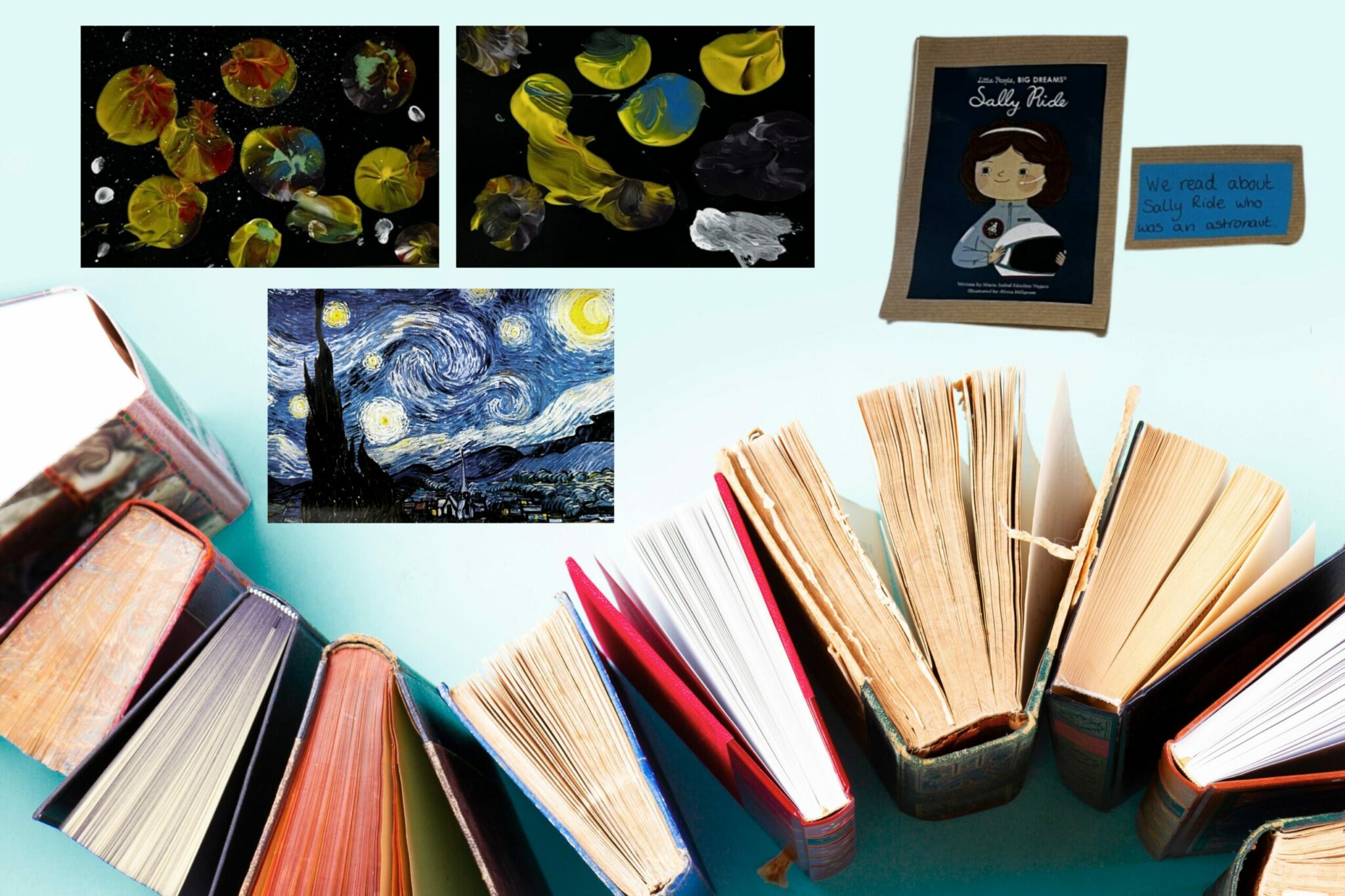
A story about astronaut Sally Ride became a journey into space exploration, the moon and the night sky. Along the way, children discovered Vincent van Gogh’s iconic Starry Night, using the famous painting as inspiration for their own artwork through painting, printing and mixed media.
More recently, Marcus Rashford’s story has helped children explore countries, cultures and communities alongside discussions inspired by the World Cup, encouraging them to think about diversity, teamwork and belonging.
The next adventure will introduce children to Harry Styles, using his story to explore individuality, confidence and self-expression before linking these ideas to the colourful abstract artwork of Wassily Kandinsky, whose belief that music and colour were connected and continues to inspire artists around the world.
For Nursery Manager Sam, the goal extends far beyond creating engaging activities.
“Children shouldn’t feel limited by boxes,” she explains. “We want them to know they can be creative, curious and imaginative. We want them to explore different ways of seeing the world and discover who they can become.”
That philosophy is already making a difference.
Children are naturally choosing to spend more time in creative spaces. They’re asking thoughtful questions, making links between different subjects and confidently exploring new materials and ideas. Learning becomes something they actively shape rather than simply participate in.
It’s also a powerful reminder that creativity isn’t an optional extra in early years education.
Creative learning helps children develop confidence, communication, resilience and problem-solving skills. It encourages them to express themselves, understand different perspectives and discover that there is often more than one way to approach a challenge.
These are skills that stay with children long after they leave the nursery.
At Whale Island, every story has the potential to become something much bigger.
A book about an astronaut becomes a lesson in imagination.
A famous painting becomes a conversation about perspective.
A footballer becomes an opportunity to explore the wider world.
A musician becomes a reminder that being yourself is something to celebrate.
And somewhere along the way, a child may discover a passion they never knew they had, a talent waiting to be nurtured, or a dream that begins with turning the very first page.
That is the power of literature-led learning.
It isn’t simply about reading stories.
It’s about helping children discover that one day, they can write their own.


